Research Dashboard
Deep dives into the two research projects driving my current work — hierarchical ANN quantization and knowledge-graph-augmented retrieval.
Reusable Codebooks for Two-Tier ANN Retrieval
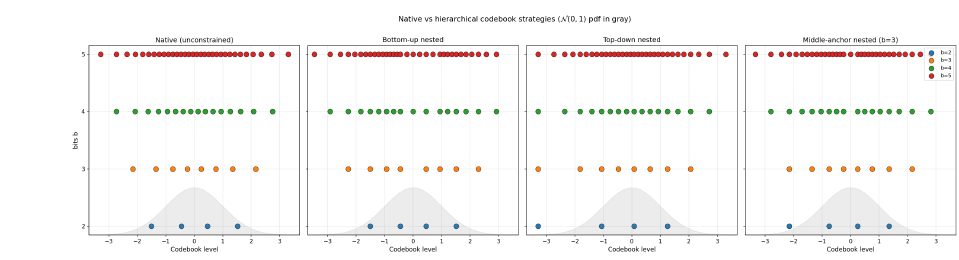
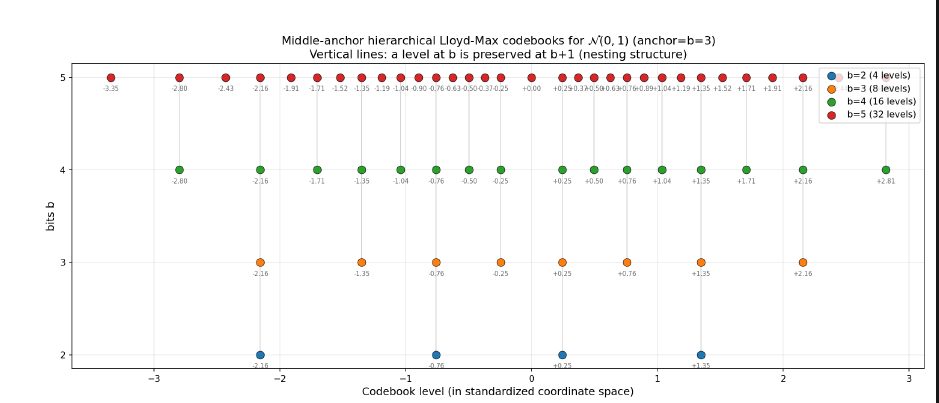
Two-tier ANN pipelines train two independent Product Quantization codebooks — one for the cheap prefilter, one for the expensive reranker — duplicating storage and training cost. Can a single nested codebook serve both tiers?
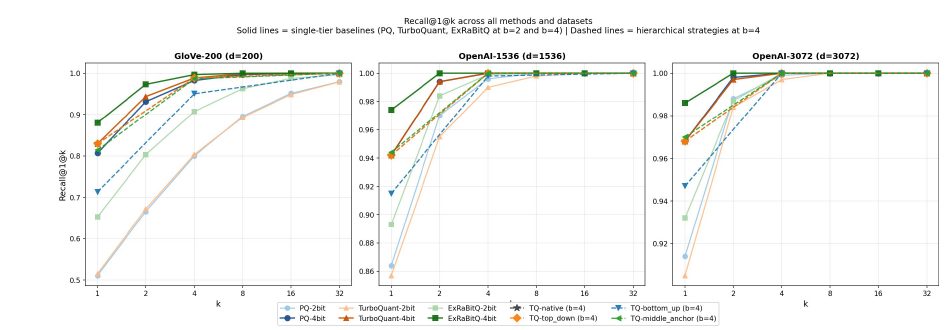
Recall@1 across methods & datasets
Nested Top-Down matches or beats unconstrained baselines.
Index construction cost (relative)
Shared codebooks collapse two trainings into one — up to 1300× cheaper.
Key Insight
Top-down decimation matches unconstrained TurboQuant within ±0.005 R@1 on all three datasets and beats PQ + reranking by +2.2 R@1 on GloVe-200 — using one shared codebook instead of two, with 50–1300× faster index construction. Bottom-up degrades by up to 12 points.
Limitations
Nesting forces an MSE redistribution: no nested family reaches zero penalty at two bit-widths at once, so low-bit tiers (b=2) pay a measurable cost. Data-oblivious codebooks lose ground to PQ on heavily anisotropic, high-dimensional corpora. Paper in prep (advisor: Prof. Ainesh Bakshi).
Erica – LLM Knowledge Graph Reasoning
Pure vector-based retrieval produces hallucinated or incoherent answers lacking structured reasoning paths.
Knowledge graph growth
LLM-driven semantic extraction over five pipeline stages.
Vector-only vs Graph-augmented RAG
Explicit reasoning paths dominate on faithfulness & hallucination.
Erica pipeline
Key Insight
Graph-augmented retrieval provides explicit reasoning paths that vector similarity alone cannot capture, measurably improving consistency over pure vector retrieval.
Limitations
Knowledge graph construction from unstructured sources requires careful schema design. Long-form outputs need asynchronous execution pipelines.